4 images in this swipe file
swipegeneral
Template: Marketing Swipe (5 sections)
AI-Powered Actions
Free account required. 5 AI credits included on signup.
Drew Rags To Riches Caples
5 of 5 sections extracted
Headline
extracted
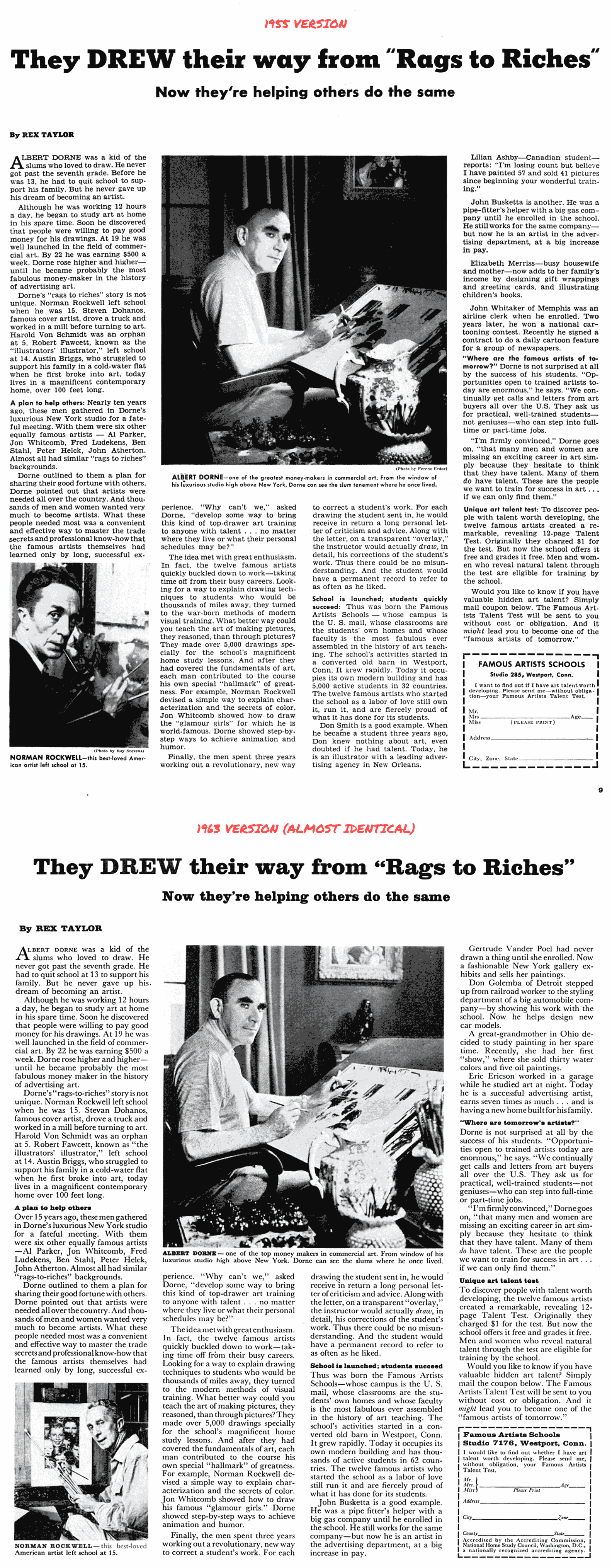
They DREW their way from “Rags to Riches”
Hook
extracted
Now they’re helping others do the same
Core Message
extracted
ALBERT DORNE was a kid of the slums who loved to draw. He never got past the seventh grade. Before he was 13, he had to quit school to support his family. But he never gave up his dream of becoming an artist. Although he was working 12 hours a day, he began to study art at home in his spare time. Soon he discovered that people were willing to pay good money for his drawings. At 19 he was well launched in the field of commercial art. By 22 he was earning $500 a week. Dorne rose higher and higher—until he became probably the most fabulous money-maker in the history of advertising art. Dorne’s “rags to riches” story is not unique. Norman Rockwell left school when he was 15. Steven Dohanos, famous cover artist, drove a truck and worked in a mill before turning to art. Harold Von Schmidt was an orphan at 5. Robert Fawcett, known as the “Illustrators’ Illustrator,” left school at 14. Austin Briggs, who struggled to support his family in a cold-water flat when he first began to draw, today lives in a magnificent contemporary home, over 100 feet long. A plan to help others: Nearly ten years ago, these men gathered in Dorne’s luxurious New York studio for a fateful meeting. With them were six other equally famous artists—Al Parker, John Whitcomb, Fred Ludekens, Ben Stahl, Peter Helck, John Atherton. Almost all had similar “rags-to-riches” backgrounds. Dorne outlined to them a plan for sharing their good fortune with others. Dorne pointed out that artists were needed all over the country. And thousands of men and women wanted very much to become artists. What these people needed most was a convenient and effective way to master the trade secrets and professional know-how that the famous artists themselves had learned only by long, successful experience. “Why can’t we,” asked Dorne, “develop some way to bring this kind of top-drawer art training to anyone who’d want it... no matter where they live or what their personal schedules may be?” The idea met with great enthusiasm. In fact, the twelve famous artists quickly buckled down to work—taking time off from their busy careers. Looking for a way to explain drawing techniques to students who would be thousands of miles away, they turned to the modern methods of visual training. What better way could you teach the art of making pictures? They reasoned that, through pictures, they made over 3,000 drawings especially for the school’s magnificent home study lessons. And after they had covered the fundamentals of art, each man contributed to the course his own special “hallmark” of greatness. For example, Norman Rockwell devised a simple way to explain characterization and the secrets of facial action. Whitcomb showed how to draw the “glamour girls” for which he is world-famous. Dorne showed step-by-step ways to achieve charm and humor. Finally, the men spent three years working out a revolutionary, new way to draw the student’s work. For each drawing the student sent in, he would receive in return a long personal letter of criticism and advice. Along with the letter, on a transparent “overlay,” the instructor would actually draw in detail, his corrections of the student’s work. Thus there could be no misunderstandings. And the student would have a permanent record to refer to as often as he liked. School is launched; students succeed: Thus was born the Famous Artists School—whose campuses at the U. S. mail, whose classrooms are the student’s own homes and whose faculty consists of the famous artists themselves. The school’s activities started in a converted barn in Westport, Conn. It grew rapidly, and today it occupies its own modern building and has thousands of active students in 47 states. The twelve famous artists who started the school as a labor of love still own it, run it, and are fiercely proud of what it has done for its students. John Busketta is a good example. He was a pipe-fitter’s helper with a big gas company. Now he helps design new car models. A great-grandmother in Ohio decided to study painting in her spare time. Recently, she had her first “show,” where she sold thirty water colors and five oil paintings. Eric Ericson worked in a garage while he studied art at night. Today he is a successful advertising artist, earns seven times as much... and is having a new home built for his family. “Where are tomorrow’s artists?” Dorne is not surprised at all by the success of his students. “Opportunities open to trained artists today are enormous,” he says. “We continually get calls and letters from art buyers all over the U.S. They ask us for practical, well-trained students—men and women—who can step into full-time or part-time jobs.” “I’m firmly convinced,” Dorne goes on, “that many men and women are missing an exciting career in art simply because they hesitate to think that they have talent. Many of them do have talent. These are the people we want to train for success in art, if we can only find them.” Unveil our talent test: To discover people with talent worth developing, the twelve famous artists created a remarkable, revealing 12-page Talent Test. Originally they charged $51 for the test. But now the school offers it free and grades it free. Men and women who reveal natural talent through the test are eligible for training by the school.
Proof Elements
extracted
Lilian Ashby—Canadian student—reports: “I’m losing count but believe I have painted 57 and sold 41 pictures since beginning your wonderful training.” John Busketta is another. He was a pipe-fitter’s helper with a big gas company. Now he helps design new car models. A great-grandmother in Ohio decided to study painting in her spare time. Recently, she had her first “show,” where she sold thirty water colors and five oil paintings. Eric Ericson worked in a garage while he studied art at night. Today he is a successful advertising artist, earns seven times as much... and is having a new home built for his family.
Call to Action
extracted
Would you like to know if you have valuable hidden art talent? Simply mail the coupon below. The Famous Artists’ Talent Test will be sent to you without cost or obligation. And if you would like to become one of the nation’s most famous artists, the Famous Artists School will help you.