3 images in this swipe file
print adfinancialdavid ogilvy
Template: Print Ad (6 sections)
AI-Powered Actions
Free account required. 5 AI credits included on signup.
How To Financial Advertising Ad By David Ogilvy
by david ogilvy
5 of 6 sections extracted
Headline
extracted
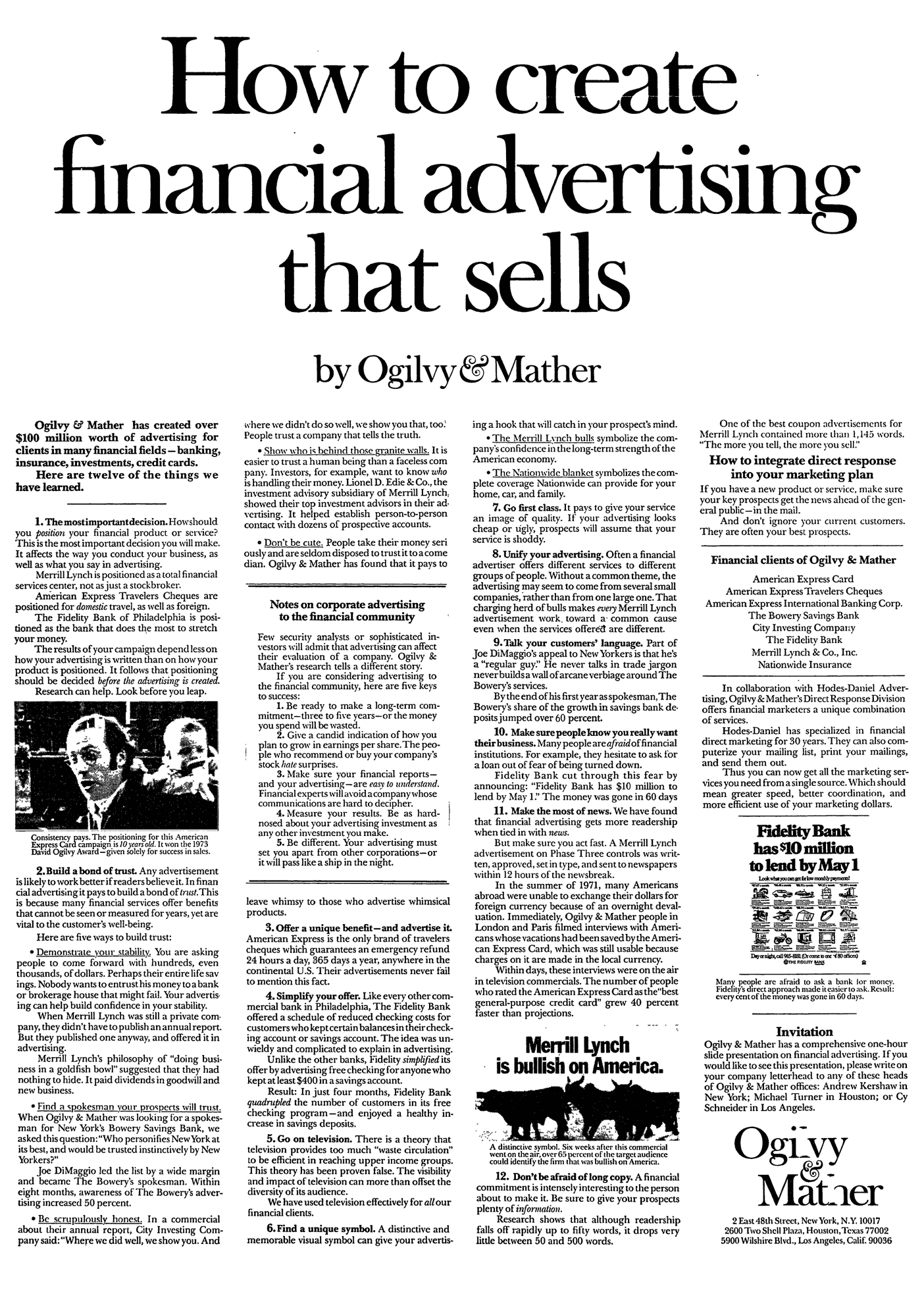
How to create financial advertising that sells
Sub-headline
extracted
by Ogilvy & Mather
Opening Hook
extracted
Ogilvy & Mather has created over $100 million worth of advertising for clients in many financial fields — banking, insurance, investments, credit cards. Here are twelve of the things we have learned.
Body Copy
extracted
1. The most important decision. How should you position your financial product or service? This is the most important decision you will make. It affects the way you conduct your business, as well as what you say in advertising. Merrill Lynch positioned a national financial services center, not just as a stockbroker. American Express Travelers Cheques are positioned for domestic travel, as well as foreign. The Fidelity Bank of Philadelphia is positioned as the bank that does the most to stretch your money. The results of your campaign depend less on how your advertising is written than on how your product is positioned. It follows that positioning should be decided before you start advertising. Research can help. Look before you leap. 2. Build a bond of trust. Any advertisement is likely to work better if it inspires belief. In finance, that is easier to say than to build. This is because many financial services offer benefits that cannot be seen or measured for years, yet are vital to the customer's well-being. Here are some ways to build trust: • Demonstrate your validity. You are asking people to come forward with hundreds, even thousands, of dollars. Perhaps their entire life savings. Nobody wants to entrust his money to a bank or brokerage house that might fail. Your advertising should instill confidence. If you are writing on behalf of Merrill Lynch, publish a photograph. They didn't have to publish an annual report, but they published one anyway, and offered it in their advertising. Merrill Lynch's photograph of 'doing business in a goldfish bowl' suggested that they had nothing to hide. It paid dividends in goodwill and business. • Find a spokesman your prospects will trust. When Ogilvy & Mather took savings for a spokesman for New York's Bowery Savings Bank, we asked the Bowery's top trustee who he would suggest and we were told unhesitatingly 'New Yorker.' Joe DiMaggio led the Yanks to a wide margin and became The Bowery's spokesman. Within six months, awareness of The Bowery's advertising had risen 50 percent. • Be scrupulously honest. In a comment about their annual report, City Investing Company said: 'Where we did well, we show you. And where we didn't do so well, we show you that, too.' People trust a company that tells the truth. • Show what is behind those granite walls. It is easier to trust a human being than a faceless company. Investors, for example, want to know who is handling their money. Lionel D. Edie & Co., the investment advisory subsidiary of Merrill Lynch, showed their top investment advisors in their advertising. It helped establish person-to-person contact with dozens of prospective accounts. • Don't be cute. People take their money seriously and are seldom disposed to trust a cutesome claim. Ogilvy & Mather has found that it pays to be honest. Notes on corporate advertising to the financial community New security analysts are sophisticated investors will tell you that advertising can affect their evaluation of a company. Ogilvy & Mather's research tells a different story. 86% of security analysts claim that advertising has no influence on their evaluation of a company. But many companies are finding advertising to be a useful tool to make a few key points: 1. Stress: 'ready to serve the long-term investor.' 2. Be candid. If you have a long-term record of success, show it. If you have a short-term record of success, show it. 3. Make sure your financial reports and annual reports are easy to read. 4. Measure what you do. Be hard-nosed. Measure your results. 5. Go on television. There is a theory that television projects too much 'visual clutter.' This theory has been proven false. Television is the richest in reach per unique impression, and many ad television can more than offset the diversity of its audience. 6. Use visuals more effectively for annual financial reports. 3. Offer a unique benefit — and advertise it. American Express is one brand of traveler's cheques which guarantees an emergency refund in 24 hours a day, 365 days a year, anywhere in the continental U.S. Their advertisements reflect the emotion of this fact. 4. Simplify your offer. Like every other commercial bank in Philadelphia, The Fidelity Bank offered a wide variety of checking accounts. But they noticed that most people were either using a checking account or savings account. The idea was suddenly complete: an 'all-in-one' account. By advertising the checking/savings account, they offered a solution to the problem of keeping track of two accounts. Result: The Fidelity Bank changed their checking account program — and enjoyed a healthy increase in savings deposits. 5. Go on television. There is a theory that television projects too much 'visual clutter.' This theory has been proven false. Television is the richest in reach per unique impression, and many ad television can more than offset the diversity of its audience. 6. Use visuals more effectively for annual financial reports. 7. Get fast class. It pays to give your service an image of quality. If your advertising looks cheap or shoddy, prospects will assume that your service is shoddy. 8. Unify your advertising. Often a financial advertiser offers different services to different groups of people. Without a common theme, each advertising may seem to come from several small companies rather than from one large one. That changes the results makes every Merrill Lynch advertisement work, marks' a common cause serving their behalf. 9. What your customers' language. Part of De Jager's appeal to New Yorkers is that he 'speaks' like New Yorkers and that jargon is readily grasped. 10. Make sure people know you really want their business. Many people already familiar with your company, but they hesitate to ask for a loan out of fear of being turned down. Introducing: 'Fidelity Bank has $10 million to lend by May 1.' The money was gone in 60 days. 11. Make the most of news. We have found that financial advertising gets more readership when tied in with news. But make sure you act fast. A Merrill Lynch advertisement on Page Three contains was an ad, in print, and sent to newspapers within 24 hours of the newsbreak. In the summer of 1971, many Americans abroad were unable to exchange their dollars for foreign currency because of an overnight devaluation. Immediately, Ogilvy & Mather people in London and Paris joined with American Express to create an advertisement in the New York Times, which said this would be the only charges on are made in the local currency. In other words, these travelers were able to charge their currency. The number of people who enrolled the American Express Card before the paper-product credit cards — grew 40 percent faster than pre-crisis. 12. Simplify your offer. Like every other commercial bank in Philadelphia, The Fidelity Bank offered a wide variety of checking accounts. But they noticed that most people were either using a checking account or savings account. The idea was suddenly complete: an 'all-in-one' account. By advertising the checking/savings account, they offered a solution to the problem of keeping track of two accounts. Result: The Fidelity Bank changed their checking account program — and enjoyed a healthy increase in savings deposits.
Call to Action
extracted
Invitation Ogilvy & Mather has a comprehensive one-hour seminar on how to improve your advertising. If you would like to attend this seminar, please indicate your company letterhead to any of the addresses of Ogilvy & Mather: Andrew Kershaw in New York; Michael Turner in Houston; or Cy Schneider in Los Angeles.
Urgency/Scarcity
empty
Limited time, limited supply, deadline...
1 sections not yet extracted: Urgency/Scarcity