2 images in this swipe file
print adgeneraldavid ogilvy
Template: Print Ad (6 sections)
AI-Powered Actions
Free account required. 5 AI credits included on signup.
How To Launch New Products Ad By David Ogilvy
by david ogilvy
4 of 6 sections extracted
Headline
extracted
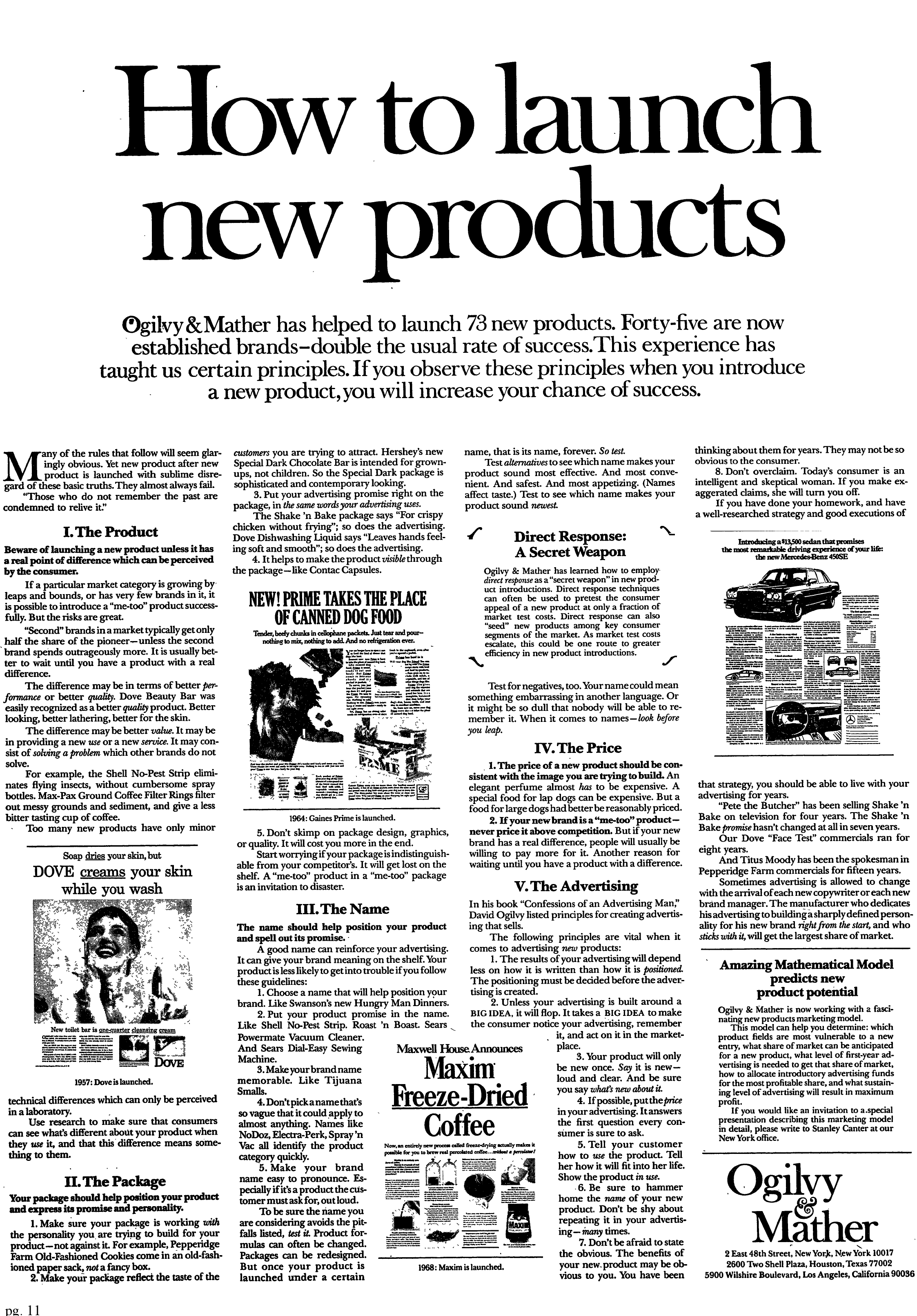
How to launch new products
Sub-headline
empty
Supporting line that builds on the promise...
Opening Hook
extracted
Ogilvy & Mather has helped to launch 73 new products. Forty-five are now established brands—double the usual rate of success. This experience has taught us certain principles. If you observe these principles when you introduce a new product, you will increase your chance of success.
Body Copy
extracted
Many of the rules that follow will seem glaringly obvious. Yet new product after new product is launched with sublime disregard of these basic truths. They almost always fail. 'Those who do not remember the past are condemned to relive it.' I. The Product Beware of launching a new product unless it has a real point of difference which can be perceived by the consumer. If a particular market category is growing by leaps and bounds, or has very few brands in it, it is possible to introduce a 'me-too' product successfully. But the risks are great. 'Second' brands in a market typically get only half the share of the pioneer—unless the second brand spends outrageously more. It is usually better to wait until you have a product with a real difference. The difference may be better value. It may be in providing a new use for a new service. It may consist of solving a problem which other brands do not solve. For example, the Shell No-Pest Strip eliminates flying insects, without cumbersome spray bottles. Max-Pax Ground Coffee Filter Rings filter out many grounds and sediment, and give a less bitter tasting cup of coffee. Too many new products have only minor technical differences which can only be perceived in a laboratory. Use a research service that consumers can see what’s different about your product when they use it, and that this difference means something to them. II. The Package Your package should help position your product and express the promise and personality. 1. Make sure your package is working with the rest of your marketing to build your product—not against it. For example, Keebler Farm Old-fashioned Cookies come in an old-fashioned paper bag. 2. Make your package reflect the taste of the customers you are trying to attract. Hershey’s new Special Dark Chocolate Bar is intended for grown-ups, not children. So the Special Dark package is sophisticated and contemporary looking. 3. Put your advertising promise right on the package, in the same words your advertising uses. The Shake ‘n Bake package says 'For crispy chicken without frying' so does the advertising. Dove Dishwashing Liquid says 'Leaves hands feeling soft and smooth,' so does the advertising. 4. It helps to make the product visible through the package—like Comet Capsules. III. The Name The name should help position your product and aid your advertising. A good name can reinforce your advertising. It helps to make the consumer see what the four most important things about your product are. The name should help position your product. It does a new product Hungry Man Dinners. Like Paul Simon says in his song 'You Can Call Me Al': 'You can call me Betty, and Betty when you call me, you can call me Al.' IV. The Price The price of a new product should be consistent with the image you are trying to establish. A special food for dogs can be expensive. But a product for a mass market has to be reasonably priced. If you are introducing a 'me-too' product—never price it above competition. But if you’re launching a new product with a real difference, be willing to pay more for it. Another reason for waiting until you have a product with a difference. V. The Advertising In his book 'Confessions of an Advertising Man,' David Ogilvy lists principles for creating advertising that sells. These principles work whether it comes to advertising new products or established brands. The most important of these principles is positioning. Positioning is what your advertising says about the product. It’s what your advertising is built around. It’s the single most important thing in marketing, more important than advertising, even more important than the product itself. Amazing Mathematical Model predicts new product potential Ogilvy & Mather has developed a fascinating new mathematical model which predicts the potential of a new product before it is launched. This model is based on the experience of launching 73 new products. It is available to our clients. If you would like an invitation to a special seminar on this new research technique, please write to Stanley Carnet at our New York office.
Call to Action
extracted
If you have done your homework, and have a well-researched strategy and good executions of that strategy, you should be able to live with your advertising for years.
Urgency/Scarcity
empty
Limited time, limited supply, deadline...
2 sections not yet extracted: Sub-headline, Urgency/Scarcity