5 images in this swipe file
print adgeneraldavid ogilvy
Template: Print Ad (6 sections)
AI-Powered Actions
Free account required. 5 AI credits included on signup.
How To Make Successful Tv Commercials Ad By David Ogilvy
by david ogilvy
5 of 6 sections extracted
Headline
extracted
How to make successful television commercials
Sub-headline
extracted
by Ogilvy & Mather
Opening Hook
extracted
Ogilvy & Mather has placed over $800,000,000 in television advertising. We have created hundreds of successful television campaigns for our clients in the United States and abroad. We have spent $4,250,000 in research on the results of these campaigns. Here is part of what we have learned.
Body Copy
extracted
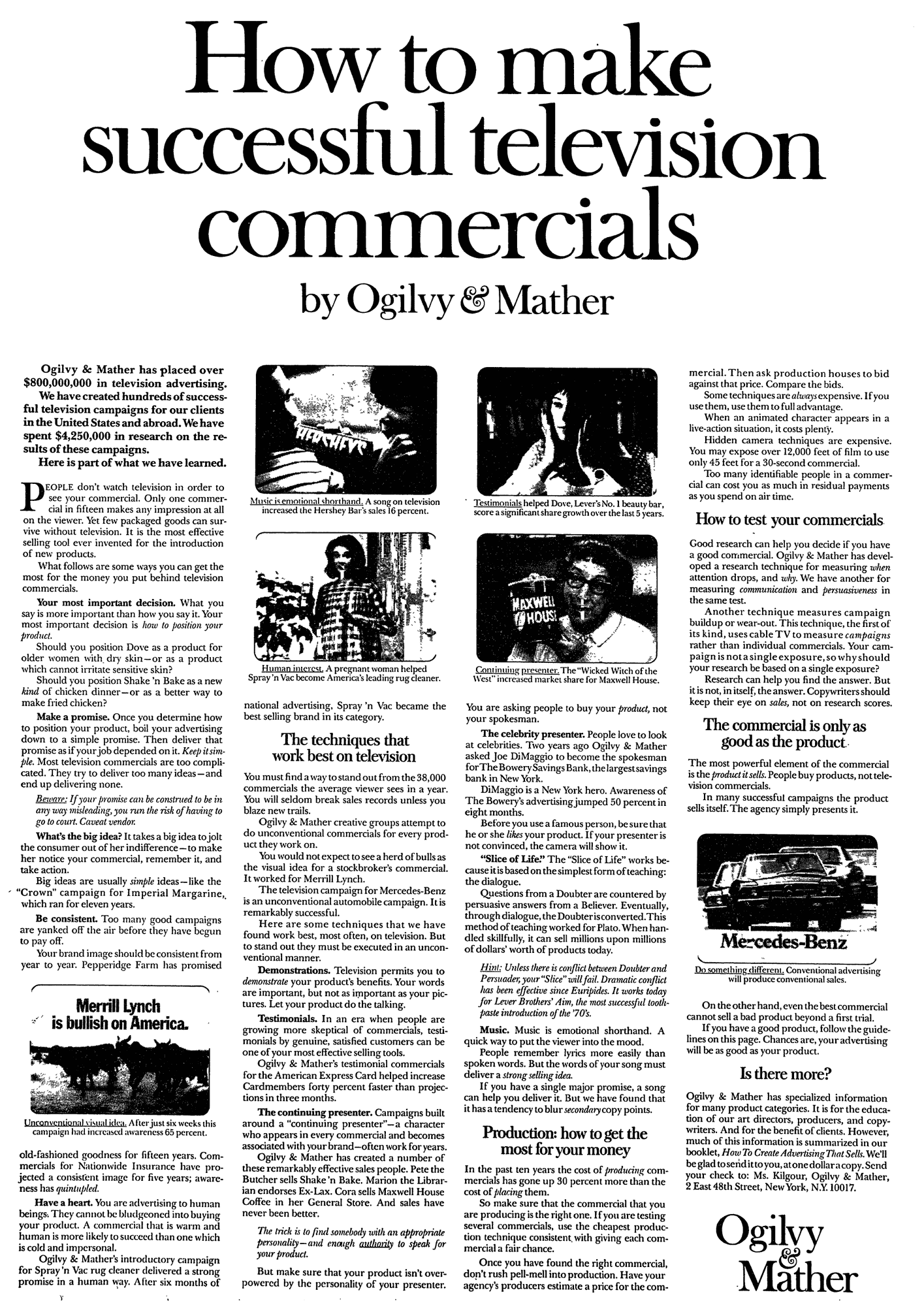
People don't watch television in order to see your commercial. Only one commercial in fifteen makes any impression at all on the viewer. Yet few packaged goods can survive without television. It is the most effective selling tool ever invented for the introduction of new products. What follows are some ways you can get the most for the money you put behind television commercials. Your most important decision. What you say is more important than how you say it. Your most important decision is how to position your product. Should you position Dove as a product for women with dry skin—or as a product which cannot irritate sensitive skin? Should you position Shake 'n Bake as a method of chicken dinner—or as a way to make fried chicken? Make a promise. Once you determine how to position your product, let your advertising boil down to a simple promise. Then deliver that promise as if your job depended on it. Keep it simple. Most television commercials are too complicated. They try to deliver too many ideas—and end up delivering none. Economy. If your promise can be contained in ten or twenty seconds, you can save the risk of having to go to court. Continued on page 82. What's the big idea? It takes a big idea to jolt the consumer out of his indifference—to make the noise your commercial, remember it, and take action. Big ideas are usually simple ideas—like the 'Crown' campaign for Imperial Margarine, which ran for eleven years. Be consistent. If you keep on making changes, you are not likely to be remembered. The average life of the average commercial is one year. Your brand image should be consistent from year to year. Experience has proved that old-fashioned footage of horses wins. Commercials for Merrill Lynch Insurance have projected a consistent image for five years; awareness has quadrupled. Have a heart. You are advertising to human beings. They cannot be blackjacked into buying your product. A commercial that is warm and human is more likely to be remembered than one which is cold and impersonal. Study the world's introductory campaign for Playtex. Their ads never delivered a strong promise in a human way. After six months of national advertising, Spray 'n Vac became the best selling brand in its category. The techniques that work best on television. You should always start out from the 88,000 commercials the average viewer sees in a year. You will seldom break sales records unless you blaze new trails. Ogilvy & Mather creative groups attempt to outwork conventional commercials for every product they work on. You should look at reels of other commercials. The visual idea for a stockbroker's commercials worked for Merrill Lynch. The television campaign for Mercedes-Benz is an unconventional automobile campaign. It has been successful. Another successful technique that we have found works on television is the use of humor. But humor must be executed in an unobtrusive manner. Demonstrations. Television permits you to demonstrate your product's benefits. Your words are important, but not as important as your pictures. Let your product do the talking. Testimonials. In an era when people are growing more skeptical of commercials, testimonials have regained some of their lost credibility. Ogilvy & Mather's first successful commercial for the American Express Card featured a famous actor in the moments before and after his performance. The continuing presenter. Campaigns built around a continuing presenter—a character who appears in every commercial and becomes enormously human—often work for many brands. The remarkable British character who sells Butcher's Bake. Make. Ralph the Lure. The continuing presenter has become the hero of the American Express Card commercials. Sales have never been better. The hidden camera. Used with appropriate discretion, the hidden camera can sell. This technique is not only visually exciting, but it can also be persuasive. Production: how to get the most for your money. The average ten years use of commercial footage has gone up 50 percent more than the cost of production. The cost of production is the same whether you are producing the script or the film. If you are testing a commercial, make sure that you are testing the finished product. Before you shoot your film, write down the price you are prepared to pay for the commercial. Then ask production houses to bid against that price. Compare the bids. Some techniques are always expensive. If you use them, use them to full advantage. When an animated character appears in a live-action situation, it costs plenty. Hidden camera techniques are expensive. You may expose over 12,000 feet of film to use only 15 feet for a 30-second commercial. Too many identifiable people in a commercial can cost you as much in residual payments as you spend on air time. How to test your commercials. Good research can help you decide if you have a good commercial. Ogilvy & Mather has developed a research technique for measuring viewer attention drops, and up. We have another for measuring communication and persuasiveness in the same test. Another technique measures campaign buildup over reach. This technique, the first of its kind, uses cable TV to measure campaigns rather than individual commercials. Your campaigns in this isolated exposure, so why should your research be based on a single exposure? Research can help you find the answer. But it isn't, if they are answer. Copywriters should keep their eye on sales, not on research scores.
Call to Action
extracted
You are asking people to buy your product, not your spokesman.
Urgency/Scarcity
empty
Limited time, limited supply, deadline...
1 sections not yet extracted: Urgency/Scarcity