print admarketingdavid ogilvy
Template: Print Ad (6 sections)
AI-Powered Actions
Free account required. 5 AI credits included on signup.
How To Run An Ad Agency Ad By David Ogilvy
by david ogilvy
4 of 6 sections extracted
Headline
extracted
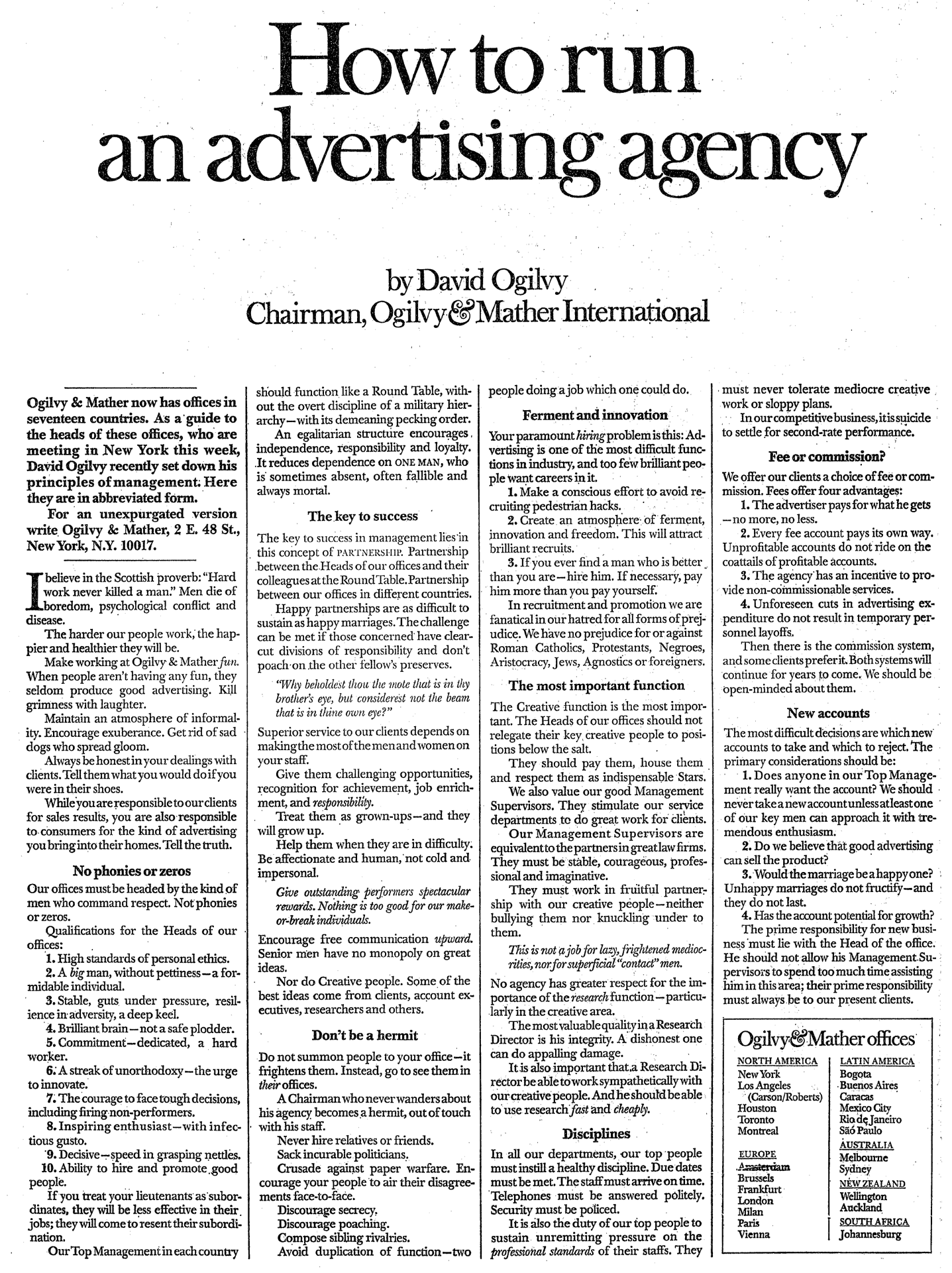
How to run an advertising agency
Sub-headline
extracted
by David Ogilvy Chairman, Ogilvy & Mather International
Opening Hook
extracted
Ogilvy & Mather now has offices in seventeen countries. As a guide to the heads of these offices, who are meeting in New York this week, David Ogilvy recently set down his principles of management. Here they are in abbreviated form.
Body Copy
extracted
I believe in the Scottish proverb: 'Hard work never killed a man.' Men die of boredom, psychological conflict and disease. The harder our people work, the happier and healthier they will be. Make working at Ogilvy & Mather fun. When people aren't having any fun, they seldom produce good advertising. Kill grimness with laughter. Maintain an atmosphere of informality. Encourage exuberance. Get rid of sad dogs who spread gloom. Always be honest in your dealings with clients. Tell them what you would do if you were in their shoes. While you are responsible to our clients for sales results, you are also responsible to consumers for the kind of advertising you bring into their homes. Tell the truth. No phonies or zeros Our offices must be headed by the kind of men who command respect. Not phonies or zeros. Qualifications for the Heads of our offices: 1. High standards of personal ethics. 2. A big man, without pettiness—a formidable individual. 3. Stable, guts, directness, resilience and gravitas; a deep keel. 4. Brilliant brain—not a safe plodder. 5. Commitment—dedicated, a hard worker. 6. A streak of unorthodoxy—the urge to innovate. 7. The courage to face tough decisions, including firing non-performers. 8. Inspiring enthusiast—with infectious gusto. 9. Decisive—speed in grasping nettles. 10. Ability to hire and promote good people. If you treat your lieutenants as subordinates, they will be less effective in their jobs. Encourage them to experiment without fear of failure. Our top Management in each country should function like a Round Table, without the overt discipline of a military hierarchy—with its demeaning pecking order. An egalitarian structure encourages independence, responsibility and loyalty. It reduces dependence on ONE MAN, who is sometimes absent, often fallible and always mortal. The key to success The key to success in management lies in this concept of PARTNERSHIP. Partnership between the Heads of our offices and their colleagues at the Round Table. Partnership between our offices in different countries. Happy partnerships are as difficult to sustain as happy marriages. The challenge can be met if those concerned have clear-cut divisions of responsibility and don't poach on the other fellow's preserves. 'Why beholdest thou the mote that is in thy brother's eye, but considerest not the beam that is in thine own eye?' Superior to service to our clients depends on making the most of the men and women on your staff. Give them challenging opportunities, recognition for achievement, childlike enjoyment, and responsibility. Treat them as grown-ups—and they will grow up. Help them when they are in difficulty. Educate and enhance them, and look out for their personal growth. Give outstanding performers spectacular rewards. Nothing is too good for our make-or-break individuals. Encourage free communication upward. Senior men have no monopoly on good ideas. Nor do Creative people. Some of the best ideas come from clients, account executives, researchers and others. Don't be a hermit Do not summon people to your office—it is an intimidating threat, so go to see them in their offices. A Chairman who wanders around his agency becomes a hunter, in touch with his staff. Never hire relatives or friends. Sack incurable politicians. Crusade against paper warfare. Encourage your people to air their disagreements face-to-face. Discourage secrecy. Avoid duplication of functions—two people doing a job which one could do. Ferment and innovation Your paramount hiring problem is this: Advertising is one of the most difficult functions in industry, and too few brilliant people want careers in it. 1. Make a conscious effort to avoid recruiting pedestrian hacks. 2. Create an atmosphere of ferment, innovation and freedom. This will attract brilliant recruits. 3. If you ever find a man who is better than you are—hire him. If necessary, pay him more than you pay yourself. In recruitment and promotion we are fanatical in our hatred of favoritism or prejudice. We have no prejudice for or against Roman Catholics, Protestants, Negroes, Aristocracy, Jews, Agnostics or foreigners. The most important function The Creative function is the most important. The Heads of our offices should not relegate their key creative people to positions below the salt. They should pay them, house them and respect them as indispensable Stars. We also value our good Management Supervisors. They must stop our service departments to do great work for clients. Our Management Supervisors are equivalent to the partners in great law firms. They must be stable, courageous, professional and imaginative. They must work in fruitful partnership with our creative people—neither dominating nor knuckling under to them. This is not a job for lazy, frightened mediocrities, nor for superficial 'contact men.' No agency has greater respect for the integrity of the research function—particularly in the creative area. A dishonest man in Research Director is as big a danger as a dishonest one in a top management. It is also important that a Research Director be able to work sympathetically with our creative people. And he should be able to inspire respect. Disciplines In all our dealings, the discipline of our people must result in healthy discipline. Due dates must be met. The staff must not waste time. Security must be assured. People must be able to rely on the delivery of our people to clients and to each other. We must never tolerate mediocre creative work or sloppy plans. In our competitive business, it is suicide to settle for second-rate performance. Fee or commission? We offer our clients a choice of fee or commission. Fees offer four advantages: 1. The advertiser pays for what he gets—no more, no less. 2. Every fee account pays its own way. Unprofitable accounts do not ride on the coattails of profitable accounts. 3. The agency has an incentive to provide non-commissionable services. 4. Unforeseen cuts in advertising expenditure do not result in temporary personnel layoffs. Then there is the commission system, which some clients prefer. Both systems will continue to be offered. We should be open-minded about them. New accounts The most difficult decisions are which new accounts to take and which to reject. The primary considerations should be: 1. Does anyone in our Top Management have any reason not to want the account? We should never take an account against the resistance of our key men. 2. Do we believe that good advertising will sell the product? 3. Would the marriage be happy? Unhappy marriages do not fructify—and they do not last. 4. Has the account potential for growth? The prime responsibility for new business must lie with the Head of the office. He should not allow his Management Supervisors to spend too much time assisting him in this role; their primary responsibility must always be to our present clients.
Call to Action
empty
What do you want them to do next?
Urgency/Scarcity
empty
Limited time, limited supply, deadline...
2 sections not yet extracted: Call to Action, Urgency/Scarcity