5 images in this swipe file
print adgeneraldavid ogilvy
Template: Print Ad (6 sections)
AI-Powered Actions
Free account required. 5 AI credits included on signup.
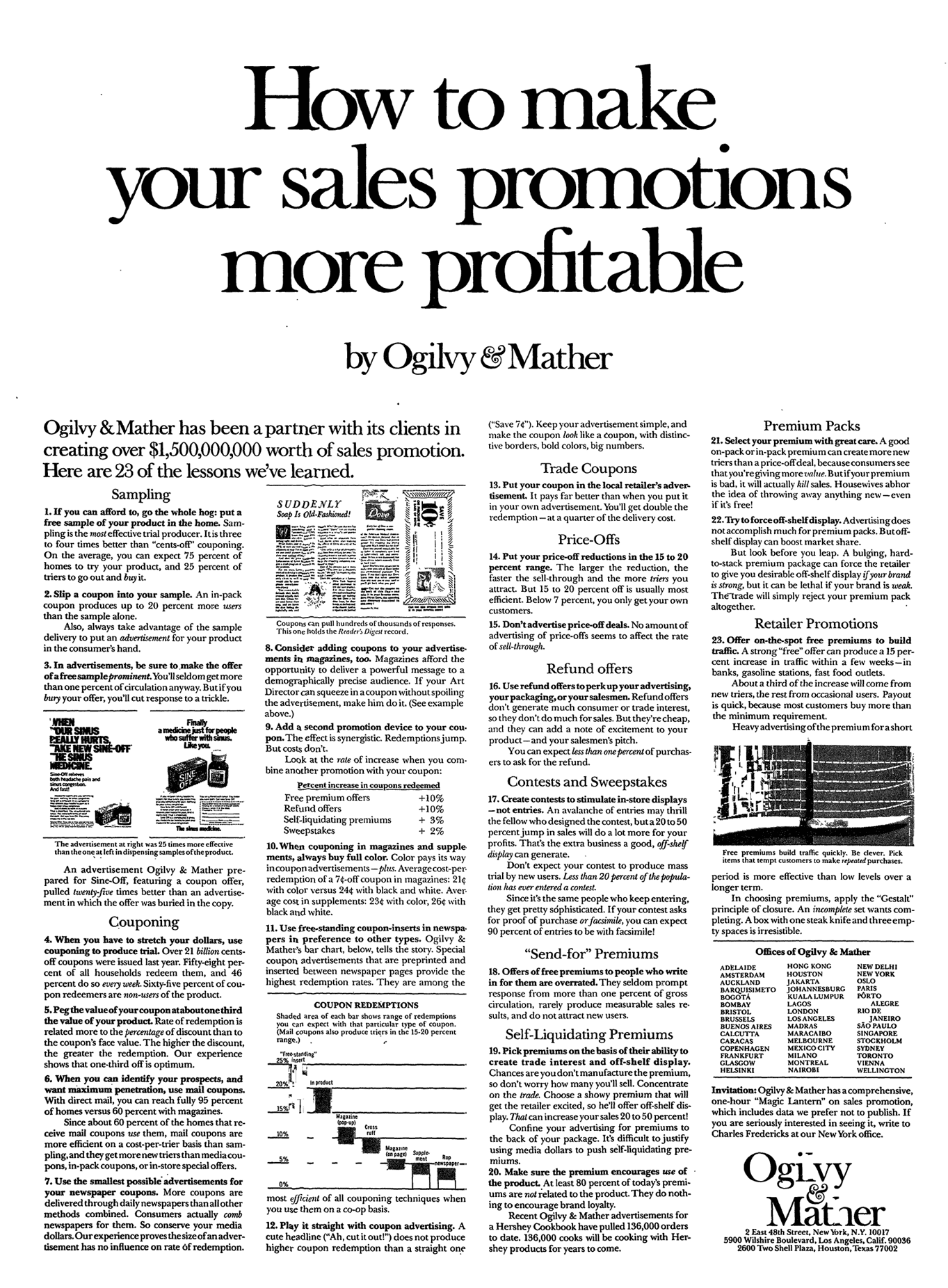
How To Sales Promo Ad By David Ogilvy
by david ogilvy
4 of 6 sections extracted
Headline
extracted
How to make your sales promotions more profitable
Sub-headline
extracted
by Ogilvy & Mather
Opening Hook
extracted
Ogilvy & Mather has been a partner with its clients in creating over $1,500,000,000 worth of sales promotion. Here are 28 of the lessons we've learned.
Body Copy
extracted
Sampling
1. If you can afford to, go the whole hog: put a free sample of your product in the home. Sampling is the most effective trial producer. It is three to four times better than 'cent-off' couponing. On the average, you can expect 75 percent of homes to try your product, and 25 percent of them to go out and buy it.
2. Slip a coupon into your sample. An in-pack coupon produces up to 20 percent more use than the sample alone.
3. In advertisements, be sure to make the offer of a free sample prominent. You’ll seldom get more than one percent of circulation anyway. But if you bury your offer, you’ll cut response to a trickle.
4. When you are testing your dollars, use couponing to produce trial. Over 21 billion cents-off coupons were used last year. Thirty-eight percent of all households redeem them, and 16 percent do so every six weeks. Sixty-five percent of coupon redeemers are new users of the product.
5. Peg the value of your coupon at about one third the value of your product. Rate of redemption is related more to the percentage discount than to the coupon’s face value. The higher the discount, the greater the redemption. Our experience shows that one third is optimum.
6. When you can identify your prospects, and want maximum redemption, use full coupons. With direct mail, you can reach fully 96 percent of homes with coupons. With magazines, the figure is about 60 percent. When the housewife clips coupons out of a magazine, she is more inclined to act on 'cent-per-item' basis than sampling, and redemption is more effective than coupons, except coupons on television.
7. Use the smallest possible advertisements for delivering your coupons. Most coupons are delivered through newspapers or other similar methods combined. Consumers usually need newspapers for them. So conserve your media dollars. Coupon redemption from an advertisement has no influence on rate of redemption.
8. Consider adding coupons to your advertisements in magazines. Magazines afford the opportunity to deliver a powerful message to a motivated audience. If your aim is to get people to try your product, you can use a coupon without spoiling the advertisement, much like in (6). See example above.
9. Add a second redemption device to your coupon. The effect is synergistic. Redemption jumps. But don’t do it.
10. Use the art of increase when you combine another promotion with your coupon:
Recent increase in coupon redemption
Free premiums + 10%
Self-liquidating premiums + 5%
Sweepstakes + 2%
11. When couponing in magazines and supplements, always be full color. Color pays by 15 percent over black and white. Average cost per redemption of a 'cent-off' coupon in magazines is 2½¢ with newspapers 2¾¢ with black and white. Average cost in supplements 2¾¢ with color, ½¢ with black and white.
12. Use the 'Save 7¢' coupon inserts in newspapers in preference to other types. Ogilvy & Mather’s chart, below, tells the story. Special inserts in newspapers are preprinted and bound between pages of the paper with the highest redemption.
Trade Coupons
13. Put your coupon in the local retailer’s advertisement. It pays far better than when you put it in your own advertisement. You’ll get double the redemption — at a quarter of the delivery cost.
Price-Offs
14. Put your price-off reductions in the 15 to 20 percent range. The larger the reduction, the faster the sell-through and the more items you attract. But 15 to 20 percent off is usually most efficient. Below 7 percent, you only get your own customers.
15. Don’t advertise price-off deals. No amount of advertising of price-offs seems to affect the rate of sell-through.
Refund offers
16. Use refund offers to support your advertising, your packaging or your salesmen. Refund offers don’t generate much consumer or trade interest, so don’t back them with media. But they do work — they can add as much as 20 percent to your product — on your salesman’s pitch.
17. You can expect less than percent of purchasers to ask for refunds.
Contests and Sweepstakes
17. Create contests to stimulate store displays — not to entice sales. An avalanche of entries may thrill the fellow who’s aligned the contest, but 20-50 percent jump in sales will do a lot more for your retailer. Create contests as a good, self-sustaining event.
18. Don’t expect your contest to produce mass sales. They can account for 20 percent of the participants.
19. If you offer the same people who keep entering, they get pretty sophisticated. If your contest asks for proof of purchase, it will help your brand.
Self-Offered Premiums
18. Offer self-premiums to people who write in for them are over-rated. They seldom prompt consumers from one brand to another. But they do generate prior mail purchase, and they do produce sales, and increase your sales.
Self-Liquidating Premiums
19. Pick premiums that bolster their ability to create trade interest and off-shelf display. Don’t choose any immaterial incentive. Create a show by your manufacturer. The premium should be chosen so they perform well that the retailer can see, so he’ll offer off-shelf display. Average order is 50 percent of the premium, but you can charge 25 percent for premiums to the cost of your package. It’s difficult to justify using media dollars on self-liquidating premiums.
20. Make sure the premium encourages a repeat of the product. At least 80 percent of today’s premiums are purchased by people who are not the product’s consumers.
21. Select your premium with great care. A good on-pack or in-pack premium can create more news than a price-off deal, because consumers see it that way. If the premium is bad, it will actually aid sales. Housewives abhor the idea of throwing away anything new — even if it’s free.
22. Try for free-off-shelf displays. Advertising does not accomplish much for premium packs. But off-shelf display can boost market share.
23. Look before you leap. A bulging, hard-to-stack premium package can force the retailer to give you desirable off-shelf display if your brand is strong, but it can be lethal if your brand is not. The retailer will simply reject your premium pack altogether.
Retailer Promotions
24. Offer co-operative promotions to build traffic. A strong 'traffic' offer can produce a 15 percent increase in traffic within a few weeks — in banks, gasoline stations, fast food outlets, or any other retail that increases will mean more business, instead of more occasional users. Prompt is quick, because most consumers buy more than the minimum requirement.
Heavy advertising the premium for a short period is more effective than low levels over a longer period.
25. Offer premiums with traffic goals, like free. Packaged goods, premiums, apply the same principle of discount. An impulse set wants consumers to think about the ticket and the empty spaces as incentives.
26. Offer premiums with traffic goals, like free. Packaged goods, premiums, apply the same principle of discount. An impulse set wants consumers to think about the ticket and the empty spaces as incentives.
27. Offer premiums with traffic goals, like free. Packaged goods, premiums, apply the same principle of discount. An impulse set wants consumers to think about the ticket and the empty spaces as incentives.
28. Offer premiums with traffic goals, like free. Packaged goods, premiums, apply the same principle of discount. An impulse set wants consumers to think about the ticket and the empty spaces as incentives.
Call to Action
empty
What do you want them to do next?
Urgency/Scarcity
empty
Limited time, limited supply, deadline...
2 sections not yet extracted: Call to Action, Urgency/Scarcity