2 images in this swipe file
swipeautomotivedavid ogilvy
Template: Marketing Swipe (5 sections)
AI-Powered Actions
Free account required. 5 AI credits included on signup.
Under Bonnet Rolls Royce Ogilvy
by david ogilvy
5 of 5 sections extracted
Headline
extracted
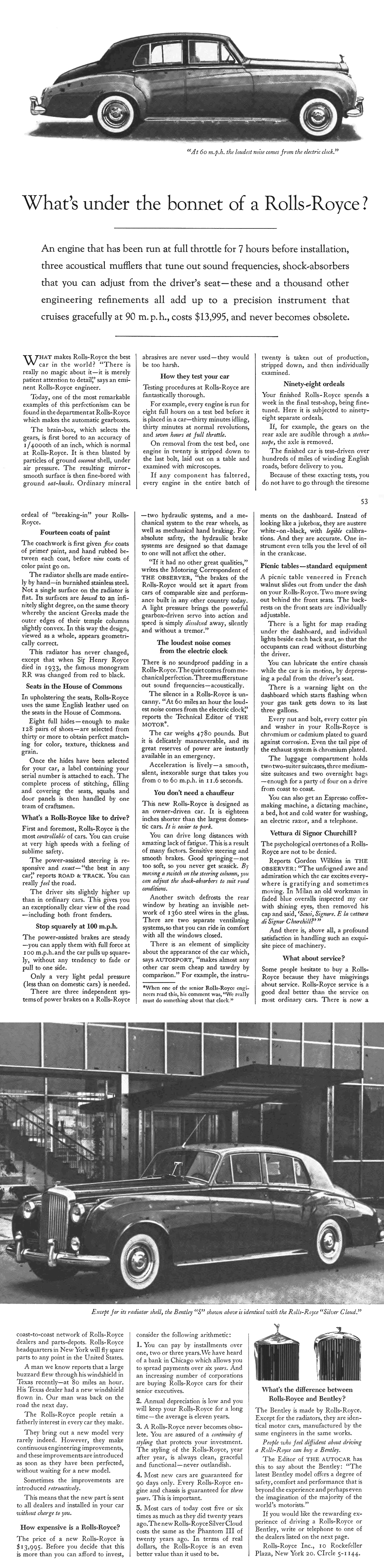
What’s under the bonnet of a Rolls-Royce?
Hook
extracted
An engine that has been run at full throttle for 7 hours before installation, three acoustical mufflers that tune out sound frequencies, shock-absorbers that you can adjust from the driver’s seat—these and a thousand other engineering refinements all add up to a precision instrument that cruises gracefully at 90 m. p. h., costs $13,995, and never becomes obsolete.
Core Message
extracted
WHAT makes Rolls-Royce the best car in the world? “Where is really no magic about it”—it is merely patient attention to detail, says an eminent Rolls-Royce engineer. Today, one of the most remarkable examples of this perfectionism can be found in the demonstration Rolls-Royce which makes the rounds of the United States. The brain-box, which selects the gears, is first baked in an oven for 4,000 hours at 60° centigrade, which is normal for a Rolls-Royce. It is then blasted by particles of ground shell, under great air pressure. The resulting mirror-smooth surface is then chrome-plated and covered with 20 coats of lacquer. The radiator shell is made entirely by hand—in burnished stainless steel. Not a single surface on the radiator is flat. Its surfaces are formed to an incredibly high degree of accuracy. The driver sits slightly higher up than in most cars. This gives him an exceptionally clear view of the road—including both front fenders. The power-assisted brakes are steady—you can apply them with full force at 100 m.p.h., and the car pulls up squarely, without any tendency to fade or pull to one side. Only a very light pedal pressure (less than one pound) is needed. There are three independent systems of power brakes on a Rolls-Royce—two hydraulic systems, and a mechanical system on the rear wheels, as well as mechanical hand braking. For absolute safety, the hydraulic brake systems are designed so that damage to one will not affect the other. “If I had no other great qualities,” writes the Motoring Correspondent of the OBSERVER, “it is a fact that a Rolls-Royce would be safer than most cars of comparable size and performance built in any other country. The high-pressure braking system (which ensures three stops in succession from 60 m.p.h. without any sign of fade) is simply devasting.” The loudest noise comes from the electric clock There is no sound inside a new Rolls-Royce. The upholstery comes from the hides of special bulls—there is no substitute for the real thing. The silence in a Rolls-Royce is uncanny. You can hear the electric clock tick. The engine is so quiet that at 60 m.p.h. the loudest noise comes from the electric clock. You don’t need a chauffeur This new Rolls-Royce is designed as owner-driver car. It is eighteen inches shorter than the largest conventional car. You can drive it downtown, park it, and get in and out of the tightest spaces. The driver switch defrosts the rear window by heating an invisible network of 130 steel wires in the glass. There are separate ventilation systems for the front and rear, to comfort all the windows closed. There is an element of simplicity about this new Rolls-Royce which, says AUTOCAR, “makes almost any other car seem cheap and tawdry by comparison.” For example, the instruments on the dashboard. Instead of looking like a jukebox, they are austere white-on-black, with Ught calibrations. And they are accurate. One instrument even tells you the level of oil in the crankcase. Picnic tables—standard equipment A picnic table veneered in French walnut pulls out from under the front seat on both sides of the car. There is a light for map reading, and a built-in mirror. The driver can read without disturbing the passenger. You can write a letter on this table, or have lunch in the car, or change your child’s diaper. You can also get an Espresso coffee-making machine, a dictating machine, a bed, and hot and cold water for washing, even television, if you desire it. The Vectura air disgorger, which removes psychological odors, is a standard feature, not to be denied. Report Gordon Wilkins in the OBSERVER: “The unflagged awe and admiration which the car excites everywhere is practically an embarrassment. In Milan old workmen in blue blouses interrupted their day’s work with shining eyes, and in a Swiss café, said, ‘Signor, E la visione di Capodanno.’ Everywhere it is the same. Satisfaction in handling such an expensive piece of machinery.
Proof Elements
extracted
Fourteen coats of paint The coachwork is first given five coats of primer paint, hand rubbed between each coat, before two coats of color go on. The radiator shell is made entirely by hand—in burnished stainless steel. Not a single surface on the radiator is flat. Its surfaces are formed to an incredibly high degree of accuracy. The driver sits slightly higher up than in most cars. This gives him an exceptionally clear view of the road—including both front fenders. The power-assisted brakes are steady—you can apply them with full force at 100 m.p.h., and the car pulls up squarely, without any tendency to fade or pull to one side. Only a very light pedal pressure (less than one pound) is needed. There are three independent systems of power brakes on a Rolls-Royce—two hydraulic systems, and a mechanical system on the rear wheels, as well as mechanical hand braking. For absolute safety, the hydraulic brake systems are designed so that damage to one will not affect the other. “If I had no other great qualities,” writes the Motoring Correspondent of the OBSERVER, “it is a fact that a Rolls-Royce would be safer than most cars of comparable size and performance built in any other country. The high-pressure braking system (which ensures three stops in succession from 60 m.p.h. without any sign of fade) is simply devasting.” The loudest noise comes from the electric clock There is no sound inside a new Rolls-Royce. The upholstery comes from the hides of special bulls—there is no substitute for the real thing. The silence in a Rolls-Royce is uncanny. You can hear the electric clock tick. The engine is so quiet that at 60 m.p.h. the loudest noise comes from the electric clock.
Call to Action
extracted
What about service? Some people hesitate to buy a Rolls-Royce because they have apprehensions about service. Rolls-Royce service is a good deal better than the service on most ordinary cars. There is now a coast-to-coast network of Rolls-Royce dealers and parts-depots. Rolls-Royce headquarters in New York will fly spare parts to any point in the United States. A man we know reports that a large diesel truck which he was behind in Texas recently—at 60 miles an hour. His Texas dealer had a new windshield flown in. Our man was back on the road the next day. The Rolls-Royce you buy is the finest inherit it ever can be. They bring out a new model very rarely indeed. However, they make improvements in their cars continuously, and these improvements are introduced into the production line at once. Sometimes the improvements are advertised, but more often not. When you buy a Rolls-Royce, you are assured of the latest improvements in the world. What’s the difference between Rolls-Royce and Bentley? The Bentley is made by Rolls-Royce. Except for the radiator, they are identical motor cars, manufactured by the same experts, in the same factory, with the same precision. A Rolls-Royce is also a Bentley. The Editor of the AUTOCAR writes: “The Bentley is truly a remarkable car. The speed, comfort and performance are beyond anything I have ever experienced. Everything about it is of the highest quality—and the majority of the world’s motorists.” If you would like a recording explaining the differences between the Rolls-Royce and the Bentley, write or telephone for the free recording on this subject. Rolls-Royce Inc., 10 Rockefeller Plaza, New York 20. Circle 5-1144.